

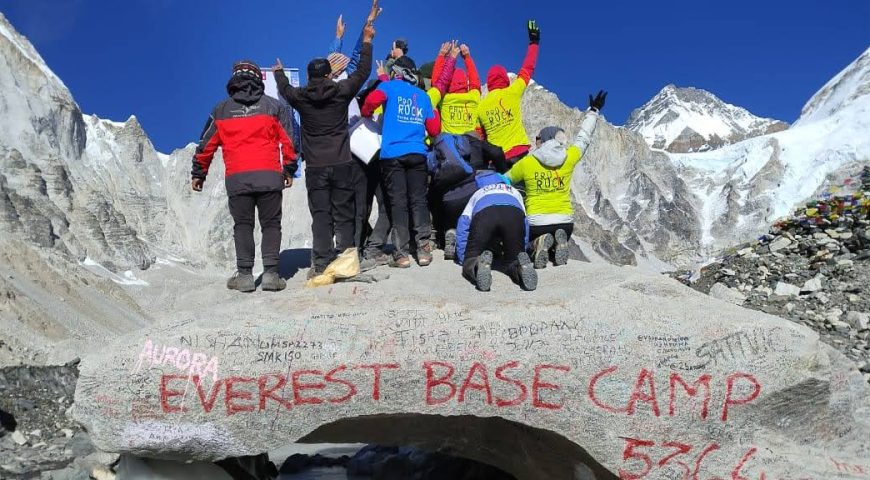
TREKKING AT THE EVEREST BASE CAMP (5364 m),November 2024 with Alpine Guide Pasquale Equizi

Here I am again with the story of my latest trip to Nepal, this time to Everest Base Camp (5364 m). A trek that I had never proposed, perhaps because of the increased flow of tourists, since we like more to discover places that are less mentioned and inflated.
But last year, talking to Dawa, our Nepalese guide from the agency that follows us in Nepal, we decided to go in November because there are fewer trekkers.
In fact, it was such a wonderful experience that the feelings I will describe below, the enthusiasm of the participants, and the charm of Nepal led me to plan our next adventure..:Trekking to Makalu Base Camp (8468 m)The Makalu region has not yet been discovered by mass tourism and is therefore little frequented by hikers. you will find all the details online:
But here we come to the experience I and 11 others had last November: Everest or Sagarmatha, 'Mother Goddess of the Earth'often constitutes the dream par excellence of hikers: a great classic that is on average demanding in terms of physical effort and time required, but no less spectacular than others in terms of views and altitudes reached. The route goes up the Khumbu valley, populated by different ethnic groups of Tibetan origin and Buddhist faith, here the most majestic mountains of the Himalaya chain, the highest on the planet, are concentrated. On the return from Base Camp, having reached the 5545 m. of Kala Pattar, we were sufficiently acclimatised to also climb the 5550 m. of Chukhung Ri, again in the presence of theEverest (8848 m), Lhotse (8414 m), Nuptse (7861 m), Pumori (7165 m) and theAma Dablam (6856 m)
We left Bologna with a flight to Dubai and transfer to Kathmandu, we stayed 2 days to visit the city. Kathmandu, a fantastic city for one thing, Durbar Square, its Buddhist and Hindu temples, the chaos of traffic, the scent of incense mixed with strong smells, ... this is Nepal. Getting to know Dawa Sherpa, the guide, the porters and organising the last things before the trek.
The next day we drive to Ramechap and take the famous flight to Lukla airport, a fairly adrenaline-filled flight into the Everest valleys. We put on our boots and thankfully begin our 14-day trek. This time we will use the jacks as luggage transport, plus 3 sherpas and the yakaro. We start the route in the midst of tropical vegetation, through rhododendron forests, Himalayan pines, villages with their vegetable gardens and cultivated fields. The lodges are better equipped than last year's trek in Kanchenjunga, the thing that surprised me was that the path was clean of rubbish, along it there were stone posts to collect differentiated rubbish.
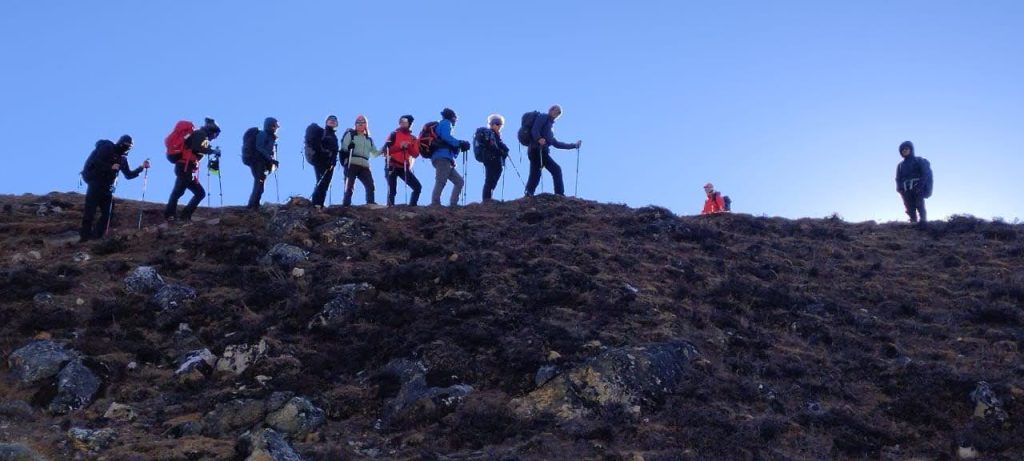
We walked from 6 to 10 hours, each day we climbed higher so that we could acclimatise, and for two days we stayed at Khumjung (3780 m) and Dimboche (4350 m) for rest and better acclimatisation.
For some, the beginning of the trek was difficult to adapt to a life perhaps never lived before, but after a few days, we got used to washing ourselves, sleeping in our sleeping bags dressed for the cold, and slowly getting used to the more demanding days of walking.
On our way we arrive at the village of Khumjung, where there is a school founded in 1961 by Sir Edmund Hillary, the first man to climb Everest together with Sherpa Tenzing Norgay on 29 May 1953. We brought more than 10 kg of school supplies for the pupils who had been relocated from a neighbouring village because it was partially destroyed by floods in August 2024. We were received by the headmaster thanking us for helping the school.
From stage to stage we reach higher altitudes and the landscape changes, from forests to bushes and the sight of snow-capped peaks, Ama Dablam with its beautiful shape, the Pumori, Lhotse and Everest in the distance.
And here we are at the laboratory of the Everest Pyramid (5050 m), built by the Italians where studies are carried out on the environment, pollution, earthquakes, and the effects on man in the high mountains; at this time there was a French team. At its foot is a small refuge, different from the lodges we have encountered so far, very similar to the ones we encounter in our mountains, built of stone and wood. A kind Nepalese manager, who speaks a little Italian, welcomes us with his smile and kindness. We resumed our walk and arrived at Gorak Shep village on the side of the Kumbu glacier, ate a hot soup, left our luggage and resumed our walk to Everest Base Camp at 5364 m, happy and excited to have arrived at our destination.
Early the next morning we set off for Kala Pattar, an easy 5550 metre peak with magnificent views of Everest, Pumori, Lotse, Nupste...We pick up the trail again and move into another valley to the village of Chukkung, where the next day's ascent to Chukkung-Ri (5550m) awaits us. Our gaze sweeps over other valleys and peaks over 8000m, enjoying the view of Cho Oyu, the Lhotse wall and Makalu.
We return by the same route taken the previous days, even though we follow the same route as the outward journey, the landscapes, the valleys, the mountains, ...appear with different eyes and we arrive in Lukla.
In the evening a good dinner, a tip for the porters and guide, a few beers and at the end some Nepalese rum accompanies us, together with the Sherpas, other foreign trekkers present in the same lodge in dances with Nepalese music and more...a beautiful evening where we met many different nationalities at a time of wars and confusion in the world ...and we all shared the end of our trek.
Dawa, our Nepalese guide and the porters were very kind and considerate, always willing to help anyone in difficulty. We had a good relationship, sometimes there were moments together of singing and dancing. The food was always plentiful with chapati, rice, eggs, soups, pulses, fresh vegetables, in the evening always fruit apples and pomegranates, chay drinks, ginger tea and coffee in the morning.
The trip to Nepal is not only a sporting and physical performance, with the return home perhaps someone becomes aware that it was also an inner journey. The realisation that one can do without so many unnecessary and superfluous things that our western world uses, the 'use' of essentials, simple food and not wasting it. Every little thing in the high altitudes is used, such as dried jack dung for fire heat or for plastering houses.
Seeing the Nepalese villagers who live with little, their smiles and greetings whenever you meet them, the simplicity and essentiality of their lives leads us to an inner reflection that remains within our hearts with the hope that something will change within us.
 Italian
 English